Can Any Graphics Card Work With Any Motherboard
What Graphics Cards Are Compatible With My PC?
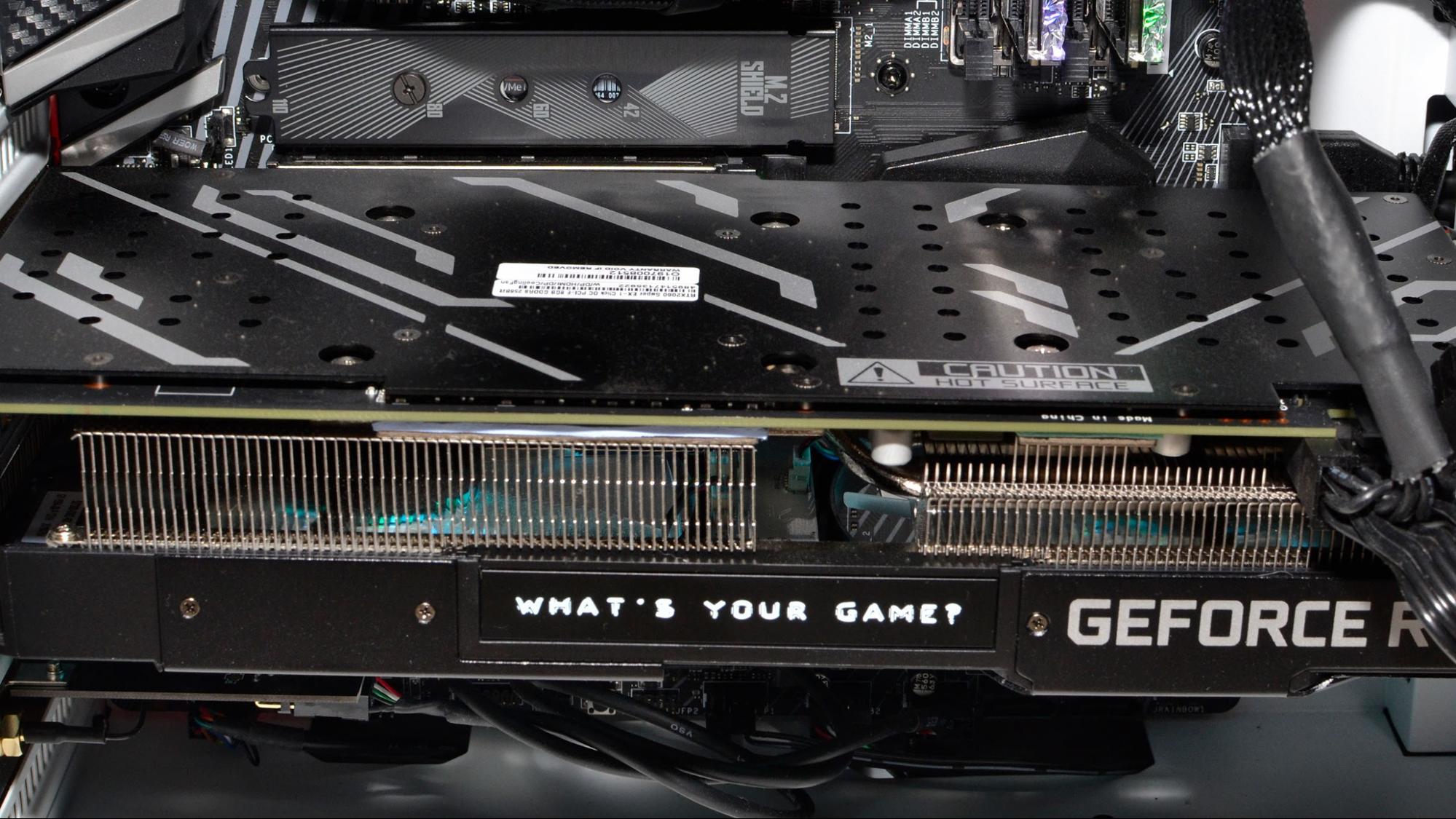
Upgrading an old PC with new hardware might sound similar a recipe for disaster. Didn't some wise person once brand a comment about putting new wine in quondam bottles? Simply you might be pleasantly surprised by but how far dorsum y'all can go with desktop PCs and still manage to install a country-of-the-art graphics menu. Nvidia RTX 2080 Ti and AMD Radeon RX 5700 XT GPUs, for case, can work in pretty much any PC built in the past decade—and likely even earlier that. But there are some caveats, particularly if your reckoner is getting a chip old and cantankerous.
To make sure a new graphics card will work with PC, you'll demand:
- PCIe x16 slot on your motherboard
- Adequate clearance space in your instance
- Power supply with both viii- and 6-pin PCIe Graphics (PEG) connectors
- CPU and RAM that are fast enough not to exist a huge bottleneck
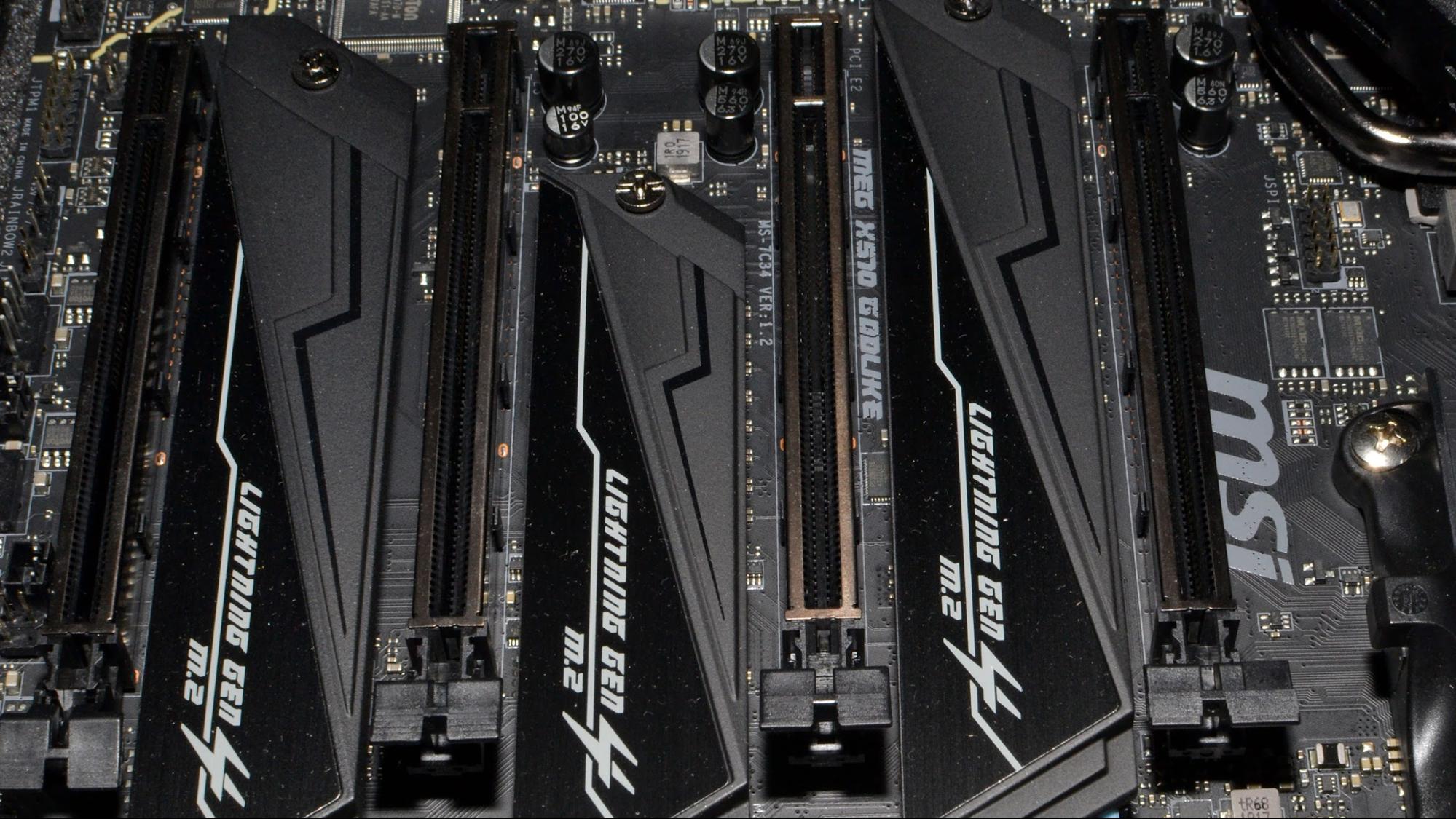
Do You Have PCIe x16?
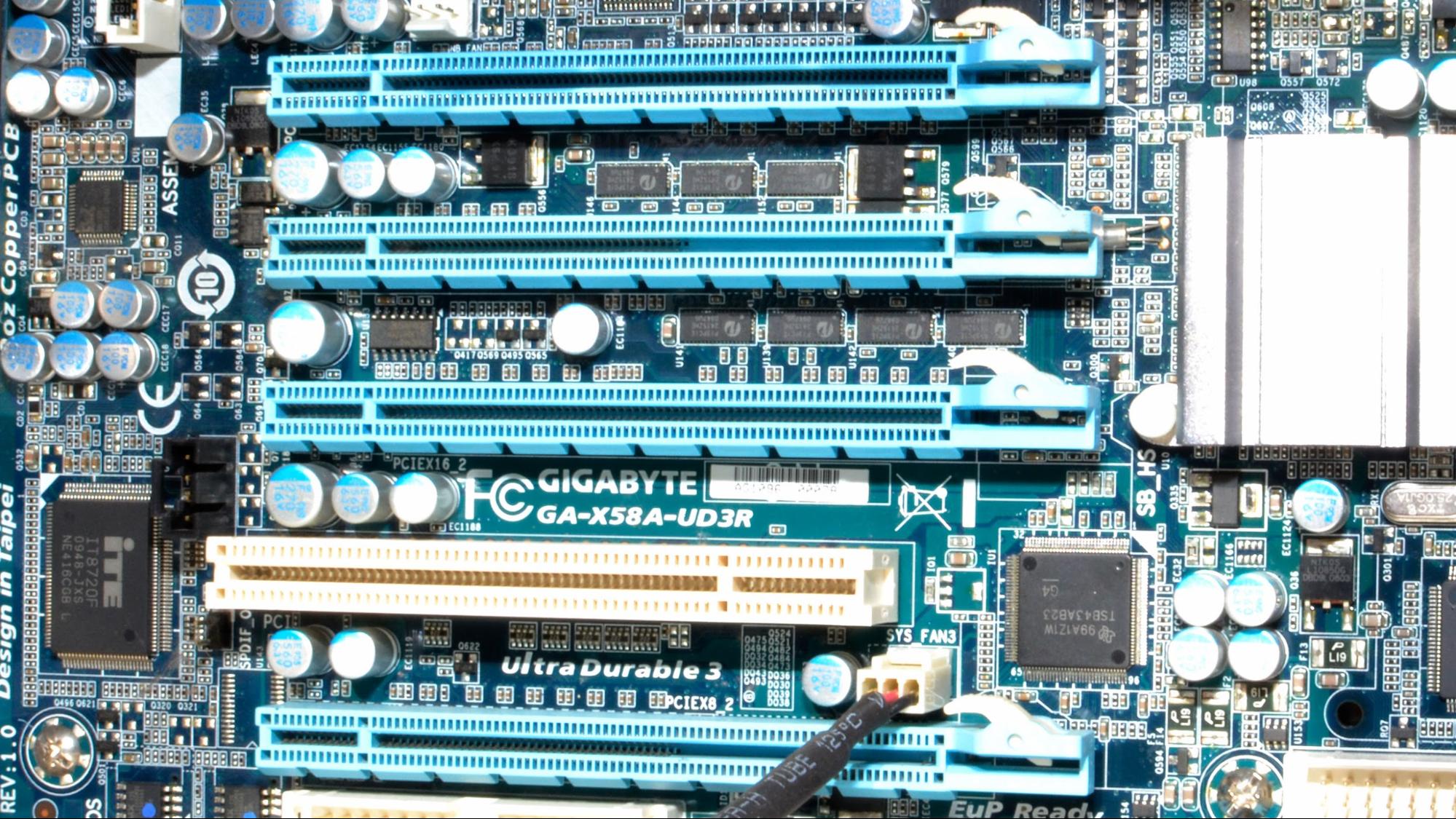
The tremendous backward compatibility of PCI Express ensures that even the newest, highest-end graphics cards can plug into a motherboard from the George Westward. Bush administration. From the original PCIe 1.0a/1.1 up through the latest PCIe 4.0, and even looking forward to future PCIe 5.0 and six.0 standards, in theory, any card that can fit in a slot volition work. You can put PCIe x1 cards in x16 slots, or have x16 slots with only x4 link widths, and everything in between. (There are potential exceptions, but by and large they're caused by bad implementations of PCIe or bad firmware.) That's pretty awesome when yous call back about information technology, especially in light of previous standards that were oftentimes deprecated. We won't shed even a single tear for the old ISA, VLB and AGP standards.
Upgrading your PC with a new graphics card is easy, then, assuming your PC really has a PCIe x16 slot. If it doesn't, we recommend forgetting virtually upgrading just your graphics card. Theoretically you might be able to finagle an x1 to x16 PCIe adapter solution, merely it's messy and merely request for trouble. If your motherboard lacks an x16 PCIe slot (see above), you should plan on upgrading your motherboard and likely your CPU, RAM and mayhap ability supply.
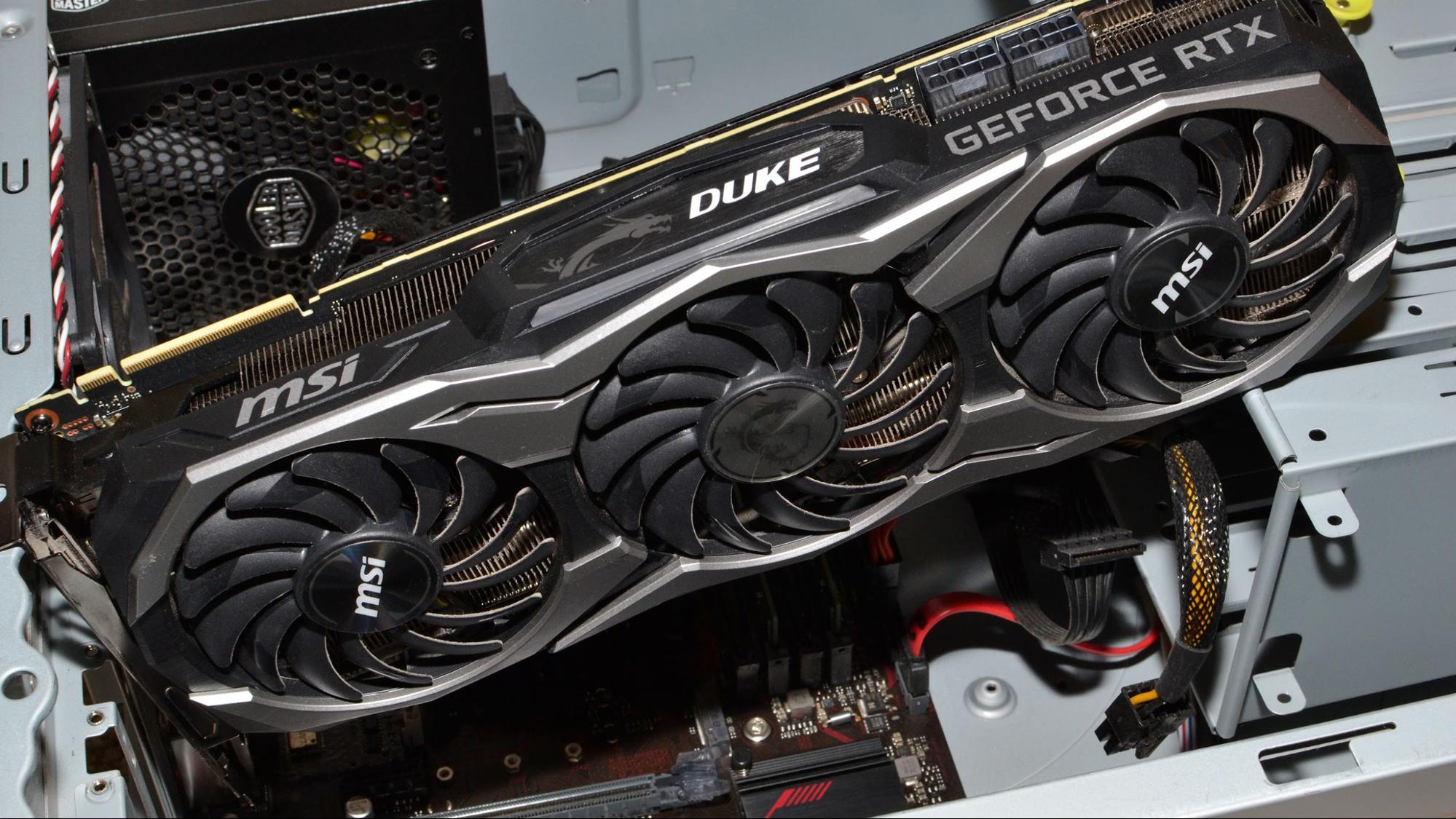
How Much Infinite in Your Instance?
That doesn't mean every old PC with a PCIe x16 slot can handle the latest graphics cards, but that's usually due to other hardware requirements. Size, for case: You lot're not going to fit a 320mm long graphics card into a case that only has room for a 270mm card. Many compact PCs will be restricted in what they can fit, and pre-congenital systems oft fall into the compact category.
To detect out how big your GPU can be, you could try looking at your case manual, bold you have that. For pre-congenital PCs, you probably won't have information technology or be able to find the data online. We recommend going old-school and using a ruler or measuring tape — it will probable take less time and requite you more accurate information.
To determine how long your graphics bill of fare tin can be, measure from the expansion slots on your example to whatsoever part is most probable to obstruct the graphics card on the other stop. It doesn't matter if it'south drive trophy, fans, or the front of the case — but measure almost your primary PCIe x16 slot (the 1 closest to the CPU cooler), equally that'south where your graphics bill of fare should become. Also pay attention to where the PEG connectors are located on whatever GPU you lot purchase. Well-nigh cards take them on the top, but some (eg, Nvidia's RTX 2060 Founders Edition) have them on the back. A tight fit at the back of your GPU could go far impossible to connect the power cables.
Nosotros recommend giving yourself some wiggle room every bit well. Even if y'all measure 300mm of clearance and a graphics card says it's 300mm long, it may be too snug a fit. Subtracting 20mm from your measurement and ownership a card that'southward shorter than the resulting length should do the pull a fast one on.
PSU Wattage Estimates
These are approximate values, with recommendations based on having power to spare.
| GPU PEG Connectors | Minimum PSU | Recommended PSU | Case Graphics Cards |
|---|---|---|---|
| Dual viii-pin PEG | 550W | 750W or larger | RTX 2080 Ti, RTX 2080 Super |
| 8-pivot plus 6-pin PEG | 500W | 650W | RTX 2070 Super, RTX 2070, RX 5700 XT, RX 5700 |
| Unmarried 8-pin PEG | 450W | 550W | RTX 2060 Super, RTX 2060, RX 5600 XT, RX 5500 XT, GTX 1660 Super |
| Dual vi-pin PEG | 450W | 550W | Deprecated - GTX 980 and GTX 970 |
| Unmarried 6-pin PEG | 350W | 400W | GTX 1660, GTX 1650 Super, GTX 1650 |
| None | 150W | 250W | GTX 1050 |
Do You Have The Right PSU?
Ability requirements are another major sticking signal. If y'all have a PC that was congenital before 2015, there'southward a good chance your ability supply won't have whatsoever 8-pivot PCI Express Graphics (PEG) power connectors available, which are used on many of the faster cards today. 6-pin PEG connectors have been around much longer, simply some budget ability supplies withal omit them. If y'all have a PC from a large OEM (eg, something from Dell, HP, or Lenovo), you might non even be able to swap out the power supply for a newer model with the required six- or 8-pin connectors.
It'southward also important to note here that while 4-pivot Molex to six-pivot PEG power adapters be, equally practise 6-pivot to viii-pivot adapters, you really shouldn't use these! Melted wires, short circuits and even fires have been started with such shenanigans. Just buy a new PSU if yous don't accept the appropriate power connectors available.
If you need a new PSU, you tin refer to the above table on recommended sizes based on how many PEG connectors a GPU needs. An 8-pin (or half dozen+two-pin) PEG connector tin can deliver up to 150W, and a 6-pin connector is for up to 75W. Not all PSUs are created equal, however, and we recommend getting an 80 Plus Golden or 80 Plus Platinum PSU — those are more efficient, which means less rut and dissonance from your PC, and usually cleaner power every bit well.
Equally for capacity,, y'all don't desire to be at the limit of your PSU. For instance, this EVGA 500W PSU has two 8-pin (six+2-pin) connectors available, and in theory could power even an RTX 2080 Ti. Your CPU, motherboard, RAM, and other components also draw power, all the same, and even if your PC is only using 400W, you probably don't desire to be that shut to the power supply's limit. In fact, optimal efficiency is often at forty-60% of a PSU's rated output.
Are Your Other Components Adept Enough?
Simply because you can do something doesn't mean you should, of grade. I have an old Intel Core i7-965 PC still kicking around that was an accented beast dorsum in early 2009 when I built information technology. More than a decade afterward, it can still practise most of what you lot might want to practice on a PC, and it has been upgraded many times over the years. It can even take a GeForce RTX 2080 Ti GPU, and it will run whatever game out at that place. What it won't exercise is run every game at high framerates.
The bottleneck in most cases isn't the PCIe 2.0 standard. Instead, it's the very-long-in-the-molar CPU, coupled with the extreme GPU. But it does piece of work—I've tried information technology and can confirm my 11-year-quondam PC fully recognizes and supports Nvidia and AMD'south latest and greatest GPUs. How fast is an RTX 2080 Ti going to exist on an older PC when compared to a new PC with a Core i9-9900K? We haven't run detailed benchmarks, but depending on the game, a Core i9-9900K can easily be over twice equally fast every bit an onetime Core i7-965, and over three times as fast as an AMD A10-7890K. If yous have an even older PC, or annihilation that but supports the PCIe i.ten standard, it'southward probably improve to look at a total PC replacement rather than just upgrading your graphics carte du jour.
Bottom Line
Ultimately, like any upgrade in PC hardware, y'all desire to consider your whole system. The good news is that if you have an old GPU fail, you can easily observe a modern replacement that will still work—and information technology will probably exist faster and support new features. Just verify that your PC has the required space and ability connectors available, and a modern PCIe graphics carte will work in any older PCIe slot. And if your PC pre-dates the PCIe era and has an AGP slot, it'southward time to put it out to pasture. Lamentable.
MORE: All-time Graphics Cards
More: GPU Benchmarks
MORE: All Graphics Content
Source: https://www.tomshardware.com/features/graphics-card-compatibility
0 Response to "Can Any Graphics Card Work With Any Motherboard"
Post a Comment